Welcome to SCRIBE
SCRIBE (Single-Cell RNA-seq Inference with Bayesian Estimation) is a comprehensive Python package for Bayesian analysis of single-cell RNA sequencing (scRNA-seq) data. Built on JAX and NumPyro, SCRIBE provides a unified framework for probabilistic modeling, variational inference, uncertainty quantification, differential expression, and model comparison in single-cell genomics.
Generative Model
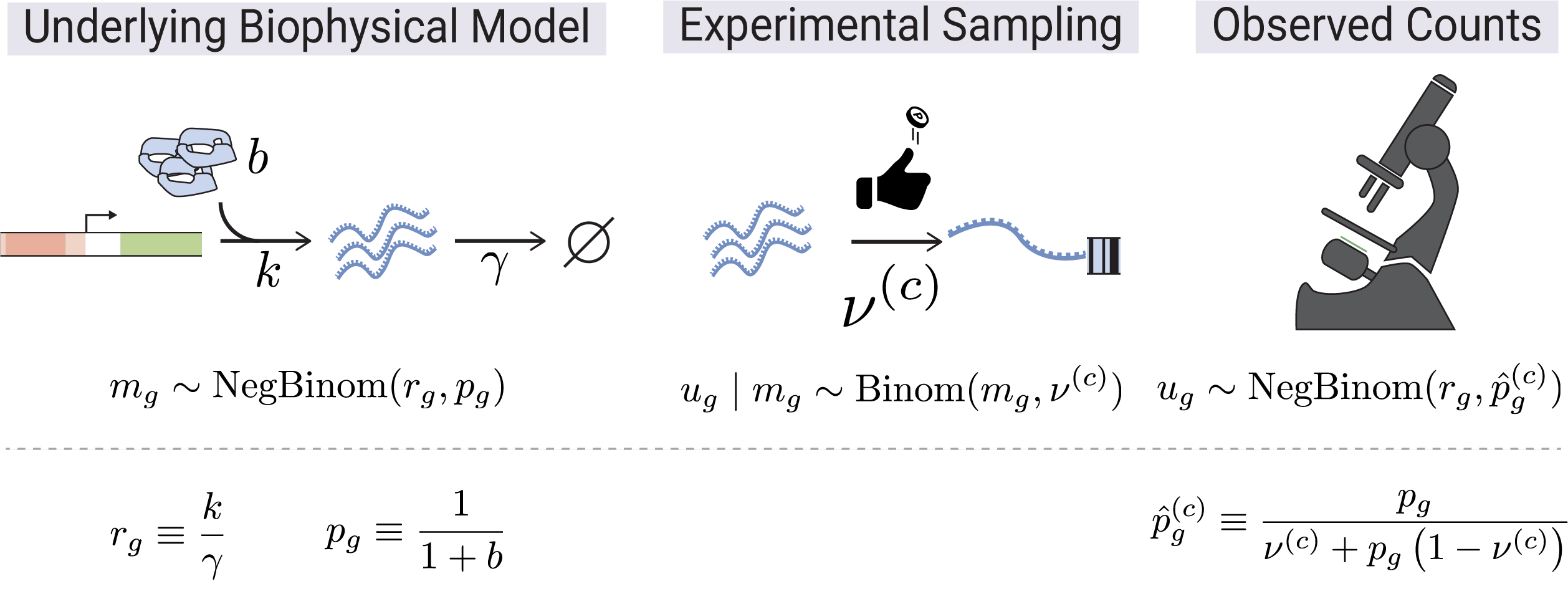
SCRIBE is grounded in a biophysical generative model of scRNA-seq count data. Transcription (rate \(b\)) and degradation (rate \(\gamma\)) set the steady-state mRNA content per gene, giving rise to a Negative Binomial distribution over true molecular counts \(m_g\) with parameters \(r_g\) and \(p_g\). During library preparation each molecule is independently captured with cell-specific probability \(\nu^{(c)}\), so the observed UMI count \(u_g\) follows a Binomial sub-sampling of \(m_g\). Marginalizing over the latent counts yields a Negative Binomial likelihood for the observations with an effective success probability \(\hat{p}_g^{(c)}\) that absorbs the capture efficiency.
For the full mathematical derivation, see the Theory section.
Why SCRIBE?
- Unified Framework: Single
scribe.fit()interface for SVI, MCMC, and VAE inference methods - Compositional Models: Four constructive likelihoods -- from the base Negative Binomial up to zero-inflated models with variable capture probability
- Compositional Differential Expression: Bayesian DE in log-ratio coordinates with proper uncertainty propagation and error control (lfsr, PEFP)
- Model Comparison: WAIC, PSIS-LOO, stacking weights, and goodness-of-fit diagnostics for principled model selection
- GPU Accelerated: JAX-based implementation with automatic GPU support
- Flexible Architecture: Three parameterizations, constrained/unconstrained modes, hierarchical priors, horseshoe sparsity, and normalizing flows
- Scalable: From small experiments to large-scale atlases with mini-batch support
- Production-Ready CLI:
scribe-inferprovides reproducible, config-driven inference with SLURM integration and automatic covariate-split orchestration;scribe-visualizegenerates diagnostic plots for any completed run
Key Features
- Three Inference Methods:
- SVI for speed and scalability
- MCMC (NUTS) for exact Bayesian inference
- VAE for representation learning with normalizing flow priors
- Constructive Likelihood System: Negative Binomial as the base, extended with zero inflation and/or variable capture probability
- Multiple Parameterizations: Canonical, mean probs, and mean odds
(with
linked/odds_ratioaliases), constrained or unconstrained priors - Advanced Guide Families: Mean-field, low-rank, joint low-rank, and amortized variational guides
- Mixture Models: K-component mixtures for cell type discovery with annotation-guided priors
- Hierarchical Priors: Gene-specific and dataset-level hierarchical structures with optional horseshoe sparsity, including crossed multi-factor (e.g. donor × condition) designs
- Bayesian Differential Expression: Parametric, empirical (Monte Carlo), and shrinkage (empirical Bayes) methods in CLR/ILR coordinates
- Model Comparison: WAIC, PSIS-LOO, stacking, per-gene elpd, and goodness-of-fit via randomized quantile residuals
- Seamless Integration: Works with AnnData and the scanpy ecosystem
Model Construction Space
SCRIBE models are built compositionally. The likelihood is constructed by layering extensions on top of a base Negative Binomial (NB) model, then configured with a parameterization, constraint mode, optional extensions, and an inference method:
%%{init: {'theme': 'base', 'themeVariables': {'primaryColor': '#dce5f1', 'primaryTextColor': '#231f20', 'primaryBorderColor': '#4f7cbb', 'lineColor': '#272C68', 'secondaryColor': '#f0e8f4', 'tertiaryColor': '#ccf1e5'}}}%%
graph TD
    subgraph likelihood ["1 - Likelihood Construction"]
        NB["Negative Binomial<br/><i>base model</i>"]
        ZINB["Zero-Inflated NB"]
        NBcapture["NB + variable capture"]
        ZINBcapture["ZINB + variable capture"]
        NB -->|"+ zero inflation"| ZINB
        NB -->|"+ variable capture"| NBcapture
        ZINB -->|"+ variable capture"| ZINBcapture
        NBcapture -->|"+ zero inflation"| ZINBcapture
    end

    subgraph parameterization ["2 - Parameterization"]
        canonical["canonical<br/><i>sample p, r directly</i>"]
        meanProbs["mean_prob<br/><i>sample p, mu; derive r</i>"]
        meanOdds["mean_odds<br/><i>sample phi, mu; derive p, r</i>"]
    end

    subgraph constraint ["3 - Constraint Mode"]
        constrained["constrained<br/><i>Beta, LogNormal, BetaPrime</i>"]
        unconstr["unconstrained<br/><i>Normal + transforms</i>"]
    end

    subgraph extensions ["4 - Optional Extensions"]
        mixture["Mixture<br/><i>K components</i>"]
        hierarchical["Hierarchical Priors<br/><i>gene-specific p, gate</i>"]
        multiDataset["Multi-Dataset<br/><i>per-dataset parameters</i>"]
        horseshoe["Horseshoe<br/><i>sparsity priors</i>"]
        annotationPrior["Annotation Priors<br/><i>soft cell-type labels</i>"]
        bioCap["Biology-Informed<br/><i>capture prior</i>"]
    end

    subgraph infer ["5 - Inference Method"]
        SVI_node["SVI<br/><i>fast, scalable</i>"]
        MCMC_node["MCMC<br/><i>exact posterior</i>"]
        VAE_node["VAE<br/><i>learned representations</i>"]
    end

    subgraph guide ["6 - Guide Family"]
        meanField["Mean-Field"]
        lowRank["Low-Rank"]
        jointLowRank["Joint Low-Rank"]
        amortized["Amortized"]
        flows["Normalizing Flows<br/><i>VAE prior</i>"]
    end

    likelihood --> parameterization
    parameterization --> constraint
    constraint --> extensions
    extensions --> infer
    SVI_node --> guide
    VAE_node --> guide

    %% Brand color styling for subgraphs
    style likelihood fill:#ccf1e5,stroke:#00b97c,stroke-width:2px
    style parameterization fill:#dce5f1,stroke:#4f7cbb,stroke-width:2px
    style constraint fill:#f0e8f4,stroke:#b48ec6,stroke-width:2px
    style extensions fill:#fcf1ce,stroke:#ebb800,stroke-width:2px
    style infer fill:#e3e5fc,stroke:#767eed,stroke-width:2px
    style guide fill:#effbfa,stroke:#28898A,stroke-width:2px
This compositional design means you can combine 4 likelihoods x 3 parameterizations x 2 constraint modes as a starting point, then layer on mixture components, hierarchical priors, multi-dataset structure, and more.
Available Models
NB family
SCRIBE's NB-family likelihoods build on each other -- the base Negative Binomial can be extended with zero inflation and/or variable capture probability:
| Likelihood | Code | Construction | Extra Parameters | Best For |
|---|---|---|---|---|
| Negative Binomial | "nbdm" |
Base model | -- | Very tight total-UMI distribution |
| NB + variable capture | "nbvcp" |
NB + capture probability | p_capture |
Typical heterogeneous library sizes |
| Zero-Inflated NB | "zinb" |
NB + zero inflation | gate |
Excess zeros after VCP ruled out |
| ZINB + variable capture | "zinbvcp" |
ZINB + capture probability | gate, p_capture |
Both ZI and VCP supported by diagnostics |
Any of these can be extended to mixture models with n_components=K for
subpopulation analysis.
Logistic-Normal Multinomial (LNM) family
LNM extends the NB family with a VAE-decoded compositional structure in additive log-ratio (ALR) coordinates. Counts factor into total counts (NB) and composition (Multinomial), with gene-gene correlations captured by a low-rank Gaussian in ALR space.
| Likelihood | Code | Construction | When to Use |
|---|---|---|---|
| LNM | "lnm" |
NB totals + VAE | Compositional inference + DE |
| LNM + variable capture | "lnmvcp" |
LNM + capture prob | LNM with variable sequencing depth |
See Logistic-Normal Multinomial for the theory.
Poisson-LogNormal (PLN) and NB-LogNormal (NBLN) families
PLN and NBLN parameterize gene-gene covariance directly through a low-rank
log-normal latent on the gene rates (Σ = WW^⊤ + diag(d)). PLN uses a Poisson
observation channel; NBLN uses NB with per-gene dispersion r_g. Both fit via
a Laplace-EM workflow with optional SVI-cascade warm-start.
| Likelihood | Code | Construction | When to Use |
|---|---|---|---|
| PLN | "pln" |
Poisson + low-rank LN | Absolute counts with explicit gene-gene covariance |
| NBLN | "nbln" |
NB + low-rank LN | PLN + per-gene overdispersion (the typical scRNA-seq case) |
See Poisson-LogNormal, NB-LogNormal, and Loadings shrinkage.
Two-state promoter (Poisson-Beta) family
The two-state promoter likelihood is a Poisson-Beta compound:
p_gc ~ Beta(α_g, β_g) and u_gc | p_gc ~ Poisson(r̂_g · p_gc · ν_c) with
p_gc independent per (gene, cell). It captures the bursty / bimodal genes
the NB family cannot fit. The closed-form NB is recovered in the
k_off → ∞ limit, so the two-state model nests inside the NB family rather
than competing with it. The marginal log-likelihood is evaluated via fixed
Gauss-Legendre quadrature over p.
| Likelihood | Code | Construction | When to Use |
|---|---|---|---|
| TwoState | "twostate" |
Poisson-Beta compound | Bursty / bimodal genes the NB cannot fit |
| TwoState + var capture | "twostatevcp" |
TwoState + capture prob | Bursty genes with variable sequencing depth |
The TwoState family ships with four parameterizations of its shape coordinate
— two_state_natural, two_state_ratio, two_state_mean_fano,
two_state_moment_delta. All four support mixture models (n_components=K)
via the same API as the NB family and both constrained (LogNormalSpec,
BetaSpec) and unconstrained (Normal + transform) guides. Under
unconstrained=True, the default positive_transform is {"mu": "exp"}
(multiplicative-step geometry for gene means that span orders of magnitude).
See Two-state promoter
for the full math and a decision guide.
Parameterizations
NB-family likelihoods (nbdm / zinb / nbvcp / zinbvcp) accept three parameterizations of the dispersion/mean structure:
| Name | parameterization= |
Aliases | Core | Derived | When to Use |
|---|---|---|---|---|---|
| Canonical | canonical |
standard |
p, r | -- | Direct interpretation |
| Mean probs | mean_prob |
linked |
p, mu | r = mu(1-p)/p | Couples mean and p |
| Mean odds | mean_odds |
odds_ratio |
phi, mu | p = 1/(1+phi), r = mu*phi | Stable when p is near 1 |
TwoState-family likelihoods (twostate / twostatevcp) accept four
parameterizations of their shape coordinate — see the
Two-state promoter theory page. PLN, NBLN,
LNM, and LNMVCP use decoder-based parameterizations auto-selected by the
factory; the parameterization argument is not exposed for those families.
Constrained vs Unconstrained
| Mode | Prior Distributions | Use Case |
|---|---|---|
| Constrained | Beta, LogNormal, BetaPrime | Default; interpretable parameters |
| Unconstrained | Normal + sigmoid/exp transforms | Optimization-friendly; required for hierarchical priors |
Quick Start
import scribe
import scanpy as sc

# Load your single-cell data
adata = sc.read_h5ad("your_data.h5ad")

# Default model includes variable capture; add low-rank guide for gene-gene correlations
results = scribe.fit(adata, guide_rank=64)

# Analyze results
posterior_samples = results.get_posterior_samples()
Customize with Simple Arguments
# Zero-inflated model with more optimization steps
results = scribe.fit(
    adata,
    zero_inflation=True,
    n_steps=100_000,
    batch_size=512,
)

# Linked parameterization with low-rank guide
results = scribe.fit(
    adata,
    model="nbdm",
    parameterization="linked",
    guide_rank=15,
)

# Mixture model for cell type discovery
results = scribe.fit(
    adata,
    zero_inflation=True,
    n_components=3,
    n_steps=150_000,
)
Choose Your Inference Method
| Method | Engine | Precision | Use Case |
|---|---|---|---|
| SVI | Adam optimizer | float32 | Fast exploration, large datasets |
| MCMC | NUTS sampler | float64 | Exact posterior, gold standard |
| VAE | Encoder-decoder | float32 | Latent representations, embeddings |
# Fast exploration with SVI (default)
svi_results = scribe.fit(adata, zero_inflation=True, n_steps=75_000)

# Exact inference with MCMC
mcmc_results = scribe.fit(
    adata,
    model="nbdm",
    inference_method="mcmc",
    n_samples=3000,
    n_chains=4,
)

# Representation learning with VAE
vae_results = scribe.fit(
    adata,
    model="nbdm",
    inference_method="vae",
    n_steps=50_000,
)
Differential Expression
SCRIBE provides a fully Bayesian differential expression framework that respects the compositional nature of scRNA-seq data. All comparisons are performed in log-ratio coordinates (CLR/ILR), propagating full posterior uncertainty.
| Method | Description | Use Case |
|---|---|---|
| Parametric | Analytic Gaussian in ALR space | Fast, requires low-rank logistic-normal fit |
| Empirical | Monte Carlo CLR differences | Assumption-free, from posterior samples |
| Shrinkage | Empirical Bayes scale-mixture prior | Improved per-gene inference, borrows strength across genes |
import jax.numpy as jnp
from scribe import compare

# Fit two conditions (default likelihood; 3-component mixture)
results_ctrl = scribe.fit(adata_ctrl, n_components=3)
results_treat = scribe.fit(adata_treat, n_components=3)

# Empirical DE between component 0 across conditions
de = compare(
    results_treat, results_ctrl,
    method="empirical",
    component_A=0, component_B=0,
)

# Gene-level results with practical significance threshold
gene_results = de.gene_level(tau=jnp.log(1.1))

# Call DE genes controlling false sign rate
is_de = de.call_genes(lfsr_threshold=0.05)
Full guide: Differential Expression
Model Comparison
Principled Bayesian model comparison with WAIC, PSIS-LOO, stacking weights, per-gene elpd differences, and goodness-of-fit diagnostics:
from scribe import compare_models

mc = compare_models(
    [results_nb, results_hierarchical],
    counts=counts,
    model_names=["NB", "Hierarchical"],
    gene_names=gene_names,
)

# Ranked comparison table
print(mc.summary())

# Per-gene elpd differences
gene_df = mc.gene_level_comparison("NB", "Hierarchical")
Full guide: Model Comparison
Getting Started
-
Installation
Install SCRIBE and set up your environment
-
Quick Overview
Understand the probabilistic approach behind SCRIBE
-
Quickstart
Run your first inference in minutes
-
Theory
Mathematical foundations of the SCRIBE models
-
Model Selection
Choose the right model for your data
-
User Guide
Inference methods, DE, model comparison, and more
-
scribe-inferCLI
Reproducible, config-driven inference with SLURM integration
-
scribe-visualizeCLI
Post-inference diagnostic plots with recursive and SLURM support
-
API Reference
Full reference for all modules and classes